Tree Removal Services for Dead, Diseased, and Storm-Damaged Trees
A tree can define a property for decades, sometimes for generations. It throws summer shade across a roofline, softens wind, shelters birds, and gives a yard the kind of maturity that new landscaping cannot fake. That is exactly why removal is never a casual recommendation. When a tree is dead, badly diseased, or structurally compromised after a storm, though, keeping it in place can become the more expensive and dangerous choice.
Property owners often wait too long because the decline feels gradual. A large oak may leaf out thinly for three springs before a major limb finally fails. A storm-damaged pine may still stand upright, even while its root plate has shifted enough to make it unsafe. I have seen homeowners assume that if a tree made it through one storm, it must be stable for the next. That is not how tree failure works. Trees frequently break in stages. The first event weakens the structure, and the second finishes the job.
Professional Tree Removal Services exist for exactly these situations. Removal is only one part of the decision, though. The best outcome often starts with a careful inspection, a realistic discussion of risk, and a clear understanding of what can still be preserved. In some cases, Tree Pruning & Crown Shaping can reduce weight and restore clearance. In others, Tree Cable and Bracing can buy time for a valuable tree with a localized structural defect. When the damage is too advanced, Dangerous Tree Assessment and Removal becomes the responsible path.
When a tree moves from unhealthy to hazardous
Not every struggling tree needs to come down. Trees are resilient, and many recover from drought, insect pressure, and moderate storm stress. The problem is that outward appearance can be misleading. A canopy that still looks green can hide extensive trunk decay. A tree with a sound trunk can still be unstable if roots were severed during construction or if saturated soil has loosened the anchorage.
Dead trees are the clearest case. Once a tree has died, the wood begins to dry, crack, and weaken. Branches become brittle, which raises the risk for anyone below. Over time, the main stem also loses integrity. How quickly that happens depends on species, size, local weather, and whether decay fungi are active. A standing dead ash, for example, can become dangerous surprisingly fast after infestation and decline. A dead hardwood in a dry climate might remain standing for longer, but that does not make it predictable.
Disease creates a more complicated decision. Some pathogens cause cosmetic damage and little structural concern. Others attack roots, trunks, or major scaffold unions, and those are the cases that keep arborists cautious. Root rot is especially serious because the tree may fail at ground level with little visible warning from a distance. Cankers can weaken key attachment points. Internal decay associated with fungal conks often signals that significant wood has already been lost.
Storm damage adds another layer because the failure pattern is rarely simple. A limb may have twisted rather than snapped, leaving torn fibers that cannot recover. A co-dominant stem may have split down the middle but remain partly attached. Lightning strikes can cook sapwood, strip bark, and compromise vascular function in ways that are not fully obvious on the day of the storm. Emergency Tree Services are often called when the danger is immediate, but many storm-damaged trees need a second evaluation a few days later, once debris is cleared and the full extent of injury can be seen.
The warning signs property owners should not ignore
People usually notice the obvious red flags, a large hanging limb, a trunk leaning over a driveway, fresh cracks in the soil near the base. The subtler clues matter just as much. Repeated branch drop in calm weather, mushrooms at the root flare, bark sloughing off in large patches, hollow-sounding trunk sections, or a canopy that is thinning from the Click for more top down all deserve attention.
One case that stays with me involved a mature maple beside a garage. From the street it looked decent enough, just a little sparse. Up close, there was included bark at a major union, some old pruning wounds, and a broad shelf fungus near the base. The owners had noticed a slight lean but assumed it had “always been that way.” During inspection, the mallet test and visual cues suggested advanced internal decay. The tree was removed the next week. When the trunk came apart on the ground, there was far less sound wood than anyone expected. Another season of wind likely would have put part of that tree through the roof.
That is where Certified Arborist Consultation matters. A trained assessment is not just about spotting dead branches. It is about reading structure, species behavior, site conditions, and defect interaction. A defect rarely exists in isolation. A weak union matters more if the canopy is overextended. Root decline matters more if the site is saturated. A lean matters more if it is recent and the target below is a home, driveway, playground, or public sidewalk.
Why timing changes both safety and cost
There is a practical side to removal that homeowners often overlook. Trees are generally easier and less costly to remove before they become a full emergency. A standing dead tree in an open yard can often be dismantled in a controlled manner with standard rigging or lift access. The same tree, after a storm splits it over a fence and entangles it in utility lines, becomes a far more delicate and expensive project.
Waiting also narrows your options. A tree that might have been retained with selective reduction pruning in year one may require full removal by year three. A cracked limb that could have been removed cleanly may fail and tear down more of the canopy. Deferred maintenance almost always creates more cleanup, more property risk, and more disruption.
Season matters, but safety matters more. There is no universal “best month” for all removals. In some regions, frozen ground helps reduce lawn disturbance from equipment. In other cases, dry-weather access Tree Pruning & Crown Shaping makes the work cleaner and safer. Urgent trees should not wait for an ideal calendar window. If a trunk is split, a root plate is heaving, or the tree is threatening a structure, the right time is as soon as qualified crews can perform the work safely.
What happens during professional Tree Removal Services
A proper removal starts before the first cut. The crew studies the tree’s condition, lean, weight distribution, surrounding targets, access for equipment, and escape routes. They identify whether the tree can be felled in one piece or must be dismantled section by section. In developed neighborhoods, removal is often a rigging job rather than a straight felling job. Limbs are lowered with ropes, friction devices, and controlled tie-in points to avoid roofs, sheds, gardens, and neighboring fences.
Storm work can be especially technical because the wood is under unusual tension and compression. A limb pinned against another branch does not behave like clean, vertical timber. Cuts must account for stored energy. That is why Emergency Tree Services should never be improvised by a property owner with a chainsaw and a ladder. People get badly hurt every year trying to clear partially attached limbs, root balls, or trees draped across structures.
Once the tree is down, debris handling becomes part of the decision. Some clients want all brush chipped and wood hauled off. Others keep usable logs for firewood if the species and condition allow it. Cleanup standards vary by contractor, so it is worth confirming whether raking, sawdust removal, and surface repair are included.
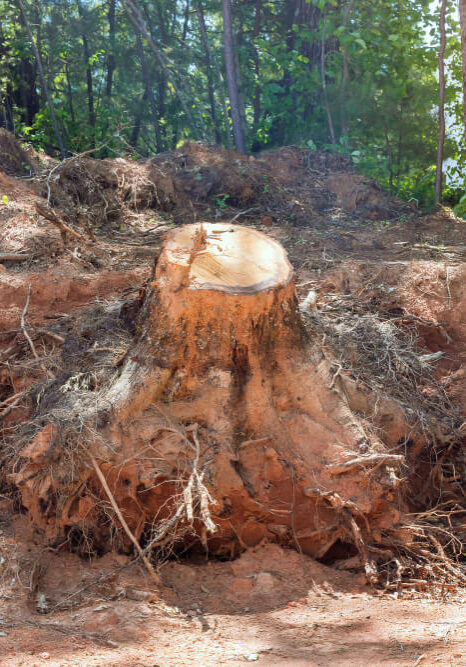
Stumps are a separate issue. Some owners leave them for habitat or future carving, but most prefer a finished surface they can mow over or replant. That is where Stump Removal & Grinding comes in. Grinding is usually the practical choice. It reduces the stump below grade and allows the area to be backfilled and restored. Full stump extraction is more invasive and may be necessary only when construction, utilities, or specific replanting plans require complete root collar removal.
Removal is not always the first recommendation
Good arborists do not sell removal when a tree can be reasonably retained. There are plenty of situations where preservation makes sense. A broad-canopied shade tree with one compromised limb may be a candidate for reduction and structural pruning. A valuable specimen with a weak union but otherwise sound health may benefit from Tree Cable and Bracing. Bracing rods and cables do not make a defective tree perfect, but in selected cases they reduce movement and lower the likelihood of failure.
Tree Pruning & Crown Shaping is also useful after moderate storm damage, especially when the goal is to restore balance and remove torn or poorly attached growth. The key is restraint. Over-thinning a damaged tree in the name of “wind resistance” often causes more stress and can stimulate weak regrowth. Restoration pruning is measured, not aggressive.
Here is the judgment call that experienced crews make every week: if the defects are isolated, the targets are limited, and the species responds well to corrective work, retention may be worthwhile. If defects are multiple, decay is advanced, targets are significant, and the tree’s response potential is poor, removal is usually the honest answer.
The role of Dangerous Tree Assessment and Removal
Risk is never zero. Even healthy trees can lose branches in severe weather. The purpose of a formal assessment is to understand the likelihood of failure, the size of the part that could fail, and what it could hit. That combination drives urgency.
Dangerous Tree Assessment and Removal often comes into play around homes, schools, parking areas, and roadways where occupancy is frequent. A defective tree deep in a woodland may be ecologically valuable as a snag. The same tree leaning over a nursery play area is a liability. Context matters.
Professionals also distinguish between chronic defects and acute defects. A cavity that has been stable for years may still require monitoring rather than immediate removal. A fresh crack after a wind event is different. Recent movement, exposed roots, suddenly lifted soil, and new separation at a main union usually mean the tree’s condition has changed, sometimes dramatically.
A sensible site visit often includes discussion of targets and use patterns. Does anyone park beneath the canopy every night? Is the area occupied daily or only a few times a month? Is there a service line, a fence, a pool enclosure? These details affect recommendations as much as the tree itself.
After storms, fast action matters, but clear judgment matters more
Storm response has its own rhythm. The phone starts ringing while rain is still falling, and many callers understandably want immediate reassurance. The first priority is life safety. If a tree is on a house, blocking an exit, threatening collapse, or tangled with electrical service, treat it as an emergency. If utility wires are involved, the utility company must be contacted before any tree work proceeds near energized lines.
For less acute situations, a quick triage helps property owners decide what needs same-day attention and what can wait a short time for proper scheduling:
- Trees touching or crushing structures need urgent professional evaluation.
- Hanging limbs over driveways, doors, or walkways should be isolated from use until removed.
- Newly leaning trees with soil lifting at the roots are high-risk and should not be approached closely.
- Trees with scattered twig loss but no major breaks can often wait for a planned inspection.
- Any tree involving power lines should be left alone until utility clearance is confirmed.
The hardest storm cases are not always the most dramatic ones. A giant limb on the lawn looks alarming, but the remaining tree may still be salvageable. Meanwhile, a tree that looks mostly intact may have a compromised root system and a much higher chance of total failure later. That is one reason Emergency Tree Services often include both immediate hazard reduction and a follow-up visit for full site evaluation.
Fire-prone regions require a different lens
In wildfire country, tree management has another purpose beyond individual tree safety. Wildfire Mitigation Tree Services focus on reducing ladder fuels, crown density in strategic areas, dead material accumulation, and direct ignition pathways near structures. Dead, dying, or heavily stressed trees can accelerate fire spread, especially when drought and bark beetle activity have already loaded a property with dry fuel.
This does not mean clear-cutting a yard. Over-thinning can increase sun exposure, stress retained trees, and change wind behavior in unhelpful ways. Smart mitigation is selective. It removes the highest-risk material, improves spacing where needed, and prioritizes defensible space around homes, outbuildings, access roads, and propane tanks. Crown lifting, deadwood removal, and selective removal of suppressed or highly flammable vegetation are often part of the plan.
I have seen properties where owners focused on ornamental landscaping near the patio while ignoring a row of dead conifers thirty feet upslope. Those conifers were the real threat. Wildfire planning works best when tree care, brush management, and building hardening are considered together rather than as separate chores.
Choosing a contractor without guessing
Tree work is one of those trades where the difference between professional and careless can be enormous. Skill is visible in the small decisions, rope angles, cut placement, communication on site, protection of lawns and hardscape, and willingness to say no when a requested shortcut would be unsafe.
When hiring, ask practical questions and expect direct answers:
- Will a Certified Arborist Consultation be part of the assessment, especially if the tree might be retained?
- Is the company insured for tree work, including liability and workers' compensation where required?
- What exactly is included in cleanup, hauling, and Stump Removal & Grinding?
- How will the crew access the site, and what steps will they take to protect turf, irrigation, and nearby plants?
- If the tree is storm-damaged, what is their plan for tensioned wood, rigging, and structure protection?
It is also worth asking how they distinguish between preservation and removal. A contractor who recommends taking down every mature tree with a cavity is not showing much judgment. On the other hand, someone who downplays obvious defects to win a cheaper pruning job is not serving you either.
What removal leaves behind, and how to plan the next step
Once a hazardous tree is gone, the site often feels strangely exposed. There is more light, more wind, and sometimes more heat on the house. That shift can be welcome or disappointing depending on why the tree mattered in the first place. Planning for replacement helps soften the loss.
Replanting should consider mature size, distance from foundations and utilities, soil limitations, and the lessons learned from the removed tree. If the previous tree failed because it outgrew a narrow planting strip or was crowded against a structure, replacing it with the same species in the same spot is rarely wise. The right tree in the right place still solves more problems than any heroic maintenance program later.
The hole left by grinding will also settle over time as chips decompose. If the area is to be seeded, sodded, or replanted, it may need soil amendment and a bit of follow-up grading. Contractors who explain this upfront usually save their clients confusion a few months later.
A practical standard for deciding
Most property owners do not need to become tree risk experts. They do need a practical standard for action. If a tree is dead, if disease has significantly weakened the trunk or roots, or if storm damage has compromised its structure near a meaningful target, prompt professional evaluation is warranted. If the defect is severe, removal is not an overreaction. It is maintenance with consequences that happen to be larger than average.
Well-run Tree Removal Services protect more than buildings. They protect people, reduce future costs, and create room for better long-term planting decisions. The best companies also know when not to remove, when Tree Pruning & Crown Shaping can restore function, when Tree Cable and Bracing can support a valued tree, and when Certified Arborist Consultation should come before any saw starts.
A mature tree deserves respect, even on its last day. That respect shows up in careful assessment, safe execution, honest recommendations, and a clean site when the work is finished. When dead, diseased, and storm-damaged trees are handled that way, removal becomes less about loss and more about responsible stewardship of the property around them.
Name: Ace Tree Services Ltd.
Address: 4656 Wallace Hill Rd, Kelowna, BC V1W 4C2, Canada
Phone: 250-212-9593
Website: https://acetree.ca/
Email: [email protected]
Hours:
Sunday: Closed
Monday: 7:00 AM–5:00 PM
Tuesday: 7:00 AM–5:00 PM
Wednesday: 7:00 AM–5:00 PM
Thursday: 7:00 AM–5:00 PM
Friday: 7:00 AM–5:00 PM
Saturday: 7:00 AM–5:00 PM
Time zone: Pacific Time
Open-location code / Plus code: RHF8+8G Kelowna, British Columbia, Canada
Map/listing URL: https://www.google.com/maps/search/?api=1&query=Google&query_place_id=ChIJxRVIBx2LfVMRNRSkp6-IC0U
Embed iframe:
Socials:
https://www.facebook.com/p/Ace-Tree-Services-61585901931447/
Ace Tree Services Ltd. provides professional tree care from its Kelowna location on Wallace Hill Road.
The official website lists tree removal, stump removal and grinding, tree pruning and crown shaping, emergency tree services, certified arborist consultation, dangerous tree assessment and removal, tree cabling and bracing, and wildfire mitigation.
Ace Tree Services serves homeowners, businesses, and property owners in Kelowna and throughout the Okanagan Valley.
The company’s official site highlights ISA Certified Arborist support, local Okanagan experience, and fully insured tree service work.
Customers can contact Ace Tree Services for planned tree maintenance, high-risk removals, storm-related tree concerns, pruning, stump grinding, and arborist consultation needs.
The supplied public listing address is 4656 Wallace Hill Rd, Kelowna, BC V1W 4C2, near rural and residential service areas in southeast Kelowna.
For tree services in Kelowna and the Okanagan, call 250-212-9593, email [email protected], or visit https://acetree.ca/
The public map listing uses plus code RHF8+8G Kelowna, British Columbia, Canada and can help customers find Ace Tree Services Ltd. near Wallace Hill Road.
Popular Questions About Ace Tree Services Ltd.
What does Ace Tree Services Ltd. do?
Ace Tree Services Ltd. provides tree removal, stump removal and grinding, tree pruning and crown shaping, emergency tree service, certified arborist consultation, dangerous tree assessment and removal, tree cabling and bracing, and wildfire mitigation.
Where is Ace Tree Services Ltd. located?
Ace Tree Services Ltd. is listed at 4656 Wallace Hill Rd, Kelowna, BC V1W 4C2, Canada.
What phone number should customers call?
Customers can call Ace Tree Services Ltd. at 250-212-9593.
What is the email address for Ace Tree Services Ltd.?
The supplied email address is [email protected].
What are Ace Tree Services Ltd.’s hours?
The supplied listing hours show Monday through Saturday from 7:00 AM to 5:00 PM, with Sunday closed, Pacific Time. The official website lists 7:00 AM to 5:00 PM, Monday through Friday, so customers should confirm Saturday availability before booking.
Does Ace Tree Services Ltd. provide emergency tree service?
Yes. The official website lists emergency tree services, including emergency tree removal, dangerous tree assessment, emergency stabilization, and limb or branch cleanup.
Does Ace Tree Services Ltd. offer arborist consultations?
Yes. The official services page lists certified arborist consultation as one of the company’s Okanagan tree services.
Does Ace Tree Services Ltd. provide stump grinding?
Yes. The official services page lists stump removal and grinding as a service.
What areas does Ace Tree Services Ltd. serve?
The official website states that Ace Tree Services serves Kelowna and the Okanagan Valley.
How do I contact Ace Tree Services Ltd.?
Call 250-212-9593, email [email protected], visit https://acetree.ca/, or use the listed social profile: Facebook.
Landmarks Near Kelowna, BC
Wallace Hill Road: The road listed for Ace Tree Services Ltd. and a practical reference point for the company’s Kelowna location.
East Kelowna: A nearby rural and residential area where tree maintenance, pruning, removals, and wildfire mitigation can be important for property owners.
Myra-Bellevue Provincial Park: A major outdoor landmark southeast of Kelowna and a useful reference for the surrounding hillside and forested areas.
Gallagher’s Canyon: A nearby Kelowna community with residential properties, mature trees, and landscape maintenance needs.
Kettle Valley: A southeast Kelowna neighborhood with homes, parks, and landscaped properties.
Mission Creek Greenway: A well-known natural corridor in Kelowna and a local reference point for tree-lined recreation areas.
Orchard Park Shopping Centre: A major Kelowna retail landmark and citywide reference point.
Downtown Kelowna: A central business and residential district within Ace Tree Services’ broader Kelowna service area.
Okanagan Lake: A major regional landmark running through Kelowna and the surrounding Okanagan Valley.
Mission Creek Regional Park: A recognizable Kelowna park and natural landmark with extensive trees and trails.
Rutland: A large Kelowna community with residential and commercial properties that may need tree service support.
Glenmore: A Kelowna neighborhood with homes, parks, and established trees.
Lower Mission: A residential and lake-adjacent Kelowna area where pruning, tree health, and property safety can matter for homeowners.
Kelowna International Airport: A major transportation landmark north of central Kelowna.
West Kelowna: A nearby Okanagan community across the lake and a practical regional service reference.
For tree removal, stump grinding, pruning, crown shaping, emergency tree service, arborist consultation, dangerous tree assessment, cabling and bracing, or wildfire mitigation near these Kelowna and Okanagan landmarks, contact Ace Tree Services Ltd. at 250-212-9593, email [email protected], or visit https://acetree.ca/